Physiotherapy Reference
Rehabilitation Protocols
A consolidated reference of all post-operative rehabilitation protocols used by Mr Getgood across each procedure. All progressions are criteria-based — timelines are approximate guides only. Physiotherapists should direct programming in conjunction with Mr Getgood's clinical review.
ACL Reconstruction
Rehabilitation Programme
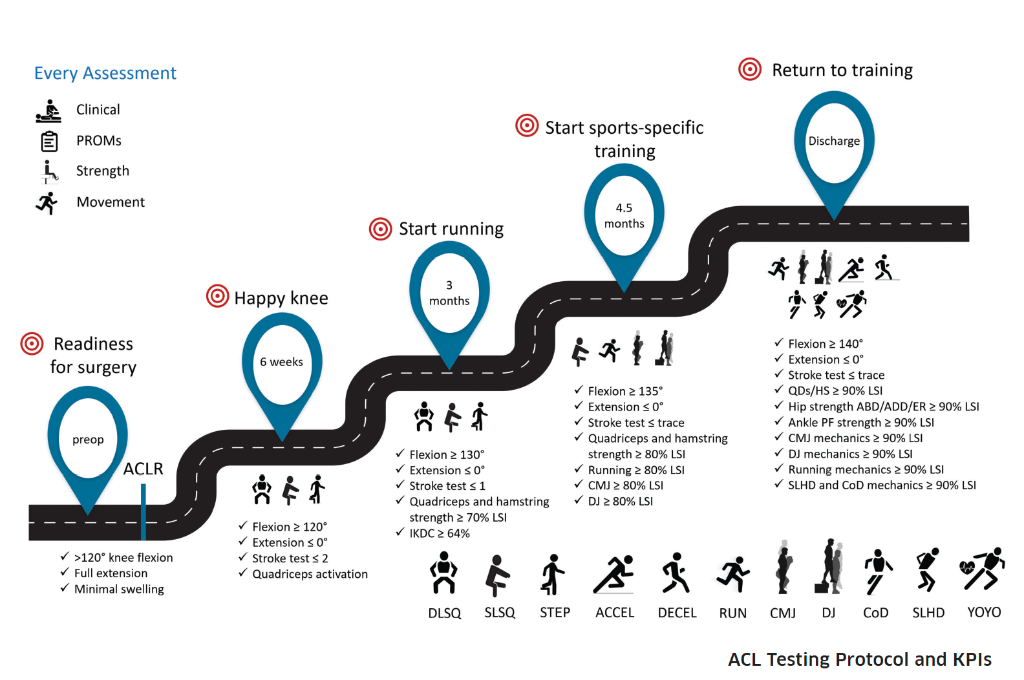
A structured, criteria-based rehabilitation programme is essential for ACL reconstruction success and safe return to sport. Through his times as Chief of Surgery at Aspetar, Mr Getgood has adopted their evidence based pathway to ACL rehabilitation and injury prevention. Progression is milestone-driven — time points are approximate guides only. It is vitally important to follow this structured programme with physiotherapy supervision.
| Time Point | Activities Allowed | Target Milestones |
|---|---|---|
Pre-Op Readiness for Surgery |
|
|
Weeks 0–2 Immediate Post-Op |
| |
Weeks 2–6 Early Healing |
|
|
Weeks 6–12 Strengthening |
|
|
Month 3 Start Running |
|
|
Month 4.5 Start Sports-Specific Training |
|
|
Discharge Return to Training / Sport |
|
|
Pre-Op
Readiness for Surgery
Activities
- Pre-operative physiotherapy to optimise knee condition
- Range of motion exercises
- Quadriceps activation and strengthening
- Swelling management
Target Milestones
- >120° knee flexion
- Full extension (0°)
- Minimal swelling
Weeks 0–2
Immediate Post-Op
Activities
- Pain and swelling management
- Restore extension to neutral (0°)
- Prevent blood clots — gentle ankle pumps, walking
- Gentle quadriceps activation
- Partial weight-bearing with crutches
- Ice compression therapy to manage swelling and pain
- Compex/muscle stimulation to assist quadriceps activation
- Blood flow restriction (BFR) therapy during lower limb exercises
Target Milestones
Weeks 2–6
Early Healing
Activities
- Progress range of motion toward 120°
- Gradual weight-bearing progression
- Quadriceps and hamstring strengthening
- Proprioceptive awareness training
- Ice compression therapy to manage swelling and pain
- Compex/muscle stimulation to assist muscle activation
- Blood flow restriction (BFR) therapy during strengthening exercises
Target Milestones
- Extension at or near 0°
- Minimal post-op swelling
- Quadriceps activation achieved
Weeks 6–12
Strengthening
Activities
- Full range of motion restoration
- Progressive resistance training
- Functional movement patterns
- Balance and coordination exercises
- Stationary bike and pool-based cardio
- Ice compression therapy to manage swelling and pain
- Compex/muscle stimulation to assist muscle activation
- Blood flow restriction (BFR) therapy during strengthening exercises
Target Milestones
- Flexion ≥120°
- Extension ≤0°
- Stroke test ≤2
- Active quadriceps contraction
Month 3
Start Running
Activities
- Jogging programme begins (criteria-based)
- Continued lower limb strengthening
- Neuromuscular control drills
- Progressive loading
- Ice compression therapy as needed for swelling management
- Compex/muscle stimulation to assist muscle activation
- Blood flow restriction (BFR) therapy during strengthening exercises
Target Milestones
- Flexion ≥130°
- Extension ≤0°
- Stroke test ≤1
- Quad & hamstring strength ≥70% LSI
- IKDC ≥64%
Month 4.5
Start Sports-Specific Training
Activities
- Sport-specific drills introduced
- Cutting and change-of-direction exercises
- Plyometric loading begins
- Running programme advancing
- Blood flow restriction (BFR) therapy during strengthening exercises
Target Milestones
- Flexion ≥135°
- Extension ≤0°
- Stroke test ≤trace
- Quad & hamstring strength ≥80% LSI
- Running ≥80% LSI
- CMJ ≥80% LSI
- DJ ≥80% LSI
Discharge
Return to Training / Sport
Activities
- Full sport-specific training
- Advanced agility and cutting drills
- Full competitive return (surgeon clearance)
Target Milestones
- Flexion ≥140°, extension ≤0°
- Stroke test ≤trace
- Quads/Hams ≥90% LSI
- Hip strength ABD/ADD/ER ≥90% LSI
- Ankle plantarflexion strength ≥90% LSI
- CMJ / DJ / running / SLHD / CoD mechanics ≥90% LSI
- Surgeon + Physio clearance
* Timelines are approximate. Exercises are given as examples only and should be directed by your physiotherapist. Progression is criteria-based and directed by your physiotherapist in conjunction with Mr Getgood's clinical review. Individual recovery varies.
PCL & Multiligament Reconstruction
Rehabilitation Programme
Rehabilitation following PCL and multiligament reconstruction is highly individualised and progresses through five structured phases. Hamstring protection is paramount in the early phases. All progressions are criteria-based and directed by your physiotherapist in conjunction with Mr Getgood's clinical review.
| Phase / Time | Brace & Weight Bearing | ROM | Exercises |
|---|---|---|---|
Phase I Weeks 0–2 Protection & Early Passive ROM | Tracker brace 0–90°, locked in extension when ambulating. Worn 24 hours/day. Flat foot feather touch weight bearing with crutches. | Prone or supine assisted knee flexion 0–90° with proximal tibia protected. No hyperextension. Patella mobilisation. | ⚠ NO ACTIVE HAMSTRINGS / KNEE FLEXION
|
Phase II Weeks 2–6 ROM & Muscle Activation | Transfer to Ossur PCL Rebound brace once soft tissue swelling allows. Flat foot partial weight bearing with crutches. | Prone or supine assisted knee flexion 0–90° with proximal tibia protected. Patella mobilisation. | ⚠ NO ACTIVE HAMSTRINGS / KNEE FLEXION
|
Phase III Weeks 6–12 ROM & Strengthening | Continue Ossur PCL Rebound brace. Weight bear as tolerated until normal heel-toe gait. | Full range of motion. Patella mobilisation. | ⚠ CAN START ACTIVE HAMSTRINGS in Ossur PCL Rebound brace only (if not in brace, keep hamstrings quiet until 12 weeks post-op)
|
Phase IV Months 3–6 Advanced Strengthening & Return to Light Work | Continue Ossur PCL Rebound brace. Weight bear as tolerated. | Full range of motion. |
|
Phase V 6+ Months Advanced Strengthening & Return to Activities | Brace use as tolerated. Full weight bearing. | Full range of motion. |
|
Phase I — Weeks 0–2
Protection & Early Passive ROM
Brace & Weight Bearing
Tracker brace 0–90°, locked in extension when ambulating. Worn 24 hours/day. Flat foot feather touch weight bearing with crutches.
ROM
Prone or supine assisted knee flexion 0–90° with proximal tibia protected. No hyperextension. Patella mobilisation.
Exercises
⚠ NO ACTIVE HAMSTRINGS / KNEE FLEXION
- Isometric quad contractions
- Gluteal activation (supine or standing)
- Isometric hip adduction/abduction
- Ankle pumping
- Ice, compression and analgesics as needed
- Compex/muscle stimulation to assist quadriceps activation
- Blood flow restriction (BFR) therapy during lower limb exercises
Phase II — Weeks 2–6
ROM & Muscle Activation
Brace & Weight Bearing
Transfer to Ossur PCL Rebound brace once soft tissue swelling allows. Flat foot partial weight bearing with crutches.
ROM
Prone or supine assisted knee flexion 0–90° with proximal tibia protected. Patella mobilisation.
Exercises
⚠ NO ACTIVE HAMSTRINGS / KNEE FLEXION
- Isometric quad contractions (± muscle stimulation)
- Gluteal activation, isometric hip adduction/abduction, ankle pumping
- Mini squats 0–30° with brace on (weight bear as tolerated during this exercise)
- Non-WB hip stability: abduction, extension, external rotation, clam shells, supine bridging on Swiss ball
- Ankle theraband plantar flexion, sitting calf raises
- Ice compression therapy to manage swelling and pain
- Blood flow restriction (BFR) therapy during strengthening exercises
Phase III — Weeks 6–12
ROM & Strengthening
Brace & Weight Bearing
Continue Ossur PCL Rebound brace. Weight bear as tolerated until normal heel-toe gait.
ROM
Full range of motion. Patella mobilisation.
Exercises
⚠ CAN START ACTIVE HAMSTRINGS in Ossur PCL Rebound brace only (if not in brace, keep hamstrings quiet until 12 weeks post-op)
- Gait retraining
- Quadriceps isometrics in long sitting and standing (± muscle stimulation)
- Weight shifting: 2 scales 50–50 WB
- Leg extension / quad over roll, active terminal knee extension with theraband
- Abdominal and core strengthening (curl-ups, transversus abdominis with SLR)
- Standing hip flexion/extension, abduction/adduction with weights/bands
- Shuttle / leg press: 2-leg squat / calf raises, progress to 1-leg; increase ROM & resistance
- Mini wall squats 30–60° → 60–90°; sit to stand
- Calf raises 2→1 foot; up-on-toes walking
- Ice compression therapy to manage swelling and pain
- Compex/muscle stimulation to assist muscle activation
- Blood flow restriction (BFR) therapy during strengthening exercises
Phase IV — Months 3–6
Advanced Strengthening & Return to Light Work
Brace & Weight Bearing
Continue Ossur PCL Rebound brace. Weight bear as tolerated.
ROM
Full range of motion.
Exercises
- Bike pendulums: ½ circles → full circles (lower seat as tolerated)
- Supine bridging: 2→1 leg Swiss ball bridge + knee flexion
- Hamstring curls: prone and sitting, progress 1–2 lb weights
- Continue core strengthening functionally (obliques, planks, Pilates)
- Sit to stand → single leg (watch mechanics)
- Progress resistance on shuttle; working on strength and endurance, 2→1 leg
- Static lunge → dynamic lunge → lunge walking
- Low resistance stationary bike
- Wobble boards with support: side-to-side and forward/backward
- Single leg stance 30–60 seconds (when full WB)
- May begin jogging/running once full ROM with quiet knee and neuromuscular control
- Blood flow restriction (BFR) therapy during strengthening exercises
Phase V — 6+ Months
Advanced Strengthening & Return to Activities
Brace & Weight Bearing
Brace use as tolerated. Full weight bearing.
ROM
Full range of motion.
Exercises
- Bungee cord walking: forward, backward, side step, lunging; add speed/direction change
- Forward and lateral step-ups 2–4–6" and eccentric lateral step-down with control
- Squats and lunges on Dynadisc / Airex / BOSU
- Hamstring curls: standing and sitting with weights/pulleys/bungee
- Single leg stance on unstable surfaces (pillow, mini-tramp, BOSU, Dynadisc)
- Standing 747s eyes open/closed → progress to mini trampoline
- Agility: cariocas, figure 8s around cones, ladder drills, lateral shuffle
- Line jumping, backward/forward/side-to-side → diagonals/combined patterns, 2→1 leg
- Jumping: tuck jumps, box jumps, long jumps
- Hopping: single-leg distance, 6 m timed, triple hop, cross-over
- Sport-specific multi-directional drills and contact when adequate core/LE patterning
* Timelines are approximate. Exercises are given as examples only and should be directed by your physiotherapist. Progression is criteria-based and directed by your physiotherapist in conjunction with Mr Getgood's clinical review. Individual recovery varies.
Patellofemoral Stabilisation
Rehabilitation Programme
Rehabilitation following patella stabilisation surgery is tailored to the specific technique(s) performed. Tibial tubercle osteotomy (TTO) requires a more protected early phase to allow bone healing, while isolated MPFL reconstruction and trochleoplasty have a faster initial progression. All progressions are criteria-based and directed by your physiotherapist in conjunction with Mr Getgood's clinical review.
| Phase / Time | Brace & Weight Bearing | ROM | Exercises |
|---|---|---|---|
Phase I Weeks 0–6 Protection & ROM | If TTO: brace locked in extension for ADLs, sleeping & ambulation (full WB in brace); remove for ROM/exercises (flat foot touch WB without brace). If no TTO: no brace, WBAT with crutches. Weeks 4–6: wean from 2→1 crutch with adequate quad control → full WB. | If TTO: 0–30° (weeks 0–2) → 0–60° (weeks 2–4) → 0–90° (weeks 4–6). If no TTO: increase as tolerated with steady weekly gains. | ⚠ TTO PATIENTS: NO active knee extension × 6 weeks
|
Phase II Weeks 6–12 Weight Bearing & Strengthening | TTO patients: advance to WBAT and wean off brace. All patients: wean off crutches. | All patients: progress to full ROM as tolerated (flexion and extension). |
|
Phase III 3–6+ Months Advanced Strengthening & Return to Activity | As tolerated per surgeon guidance. | Full range of motion. |
|
Phase I — Weeks 0–6
Protection & ROM
Brace & Weight Bearing
If TTO: brace locked in extension for ADLs, sleeping & ambulation (full WB in brace); remove for ROM/exercises (flat foot touch WB without brace). If no TTO: no brace, WBAT with crutches. Weeks 4–6: wean from 2→1 crutch with adequate quad control → full WB.
ROM
If TTO: 0–30° (weeks 0–2) → 0–60° (weeks 2–4) → 0–90° (weeks 4–6). If no TTO: increase as tolerated with steady weekly gains.
Exercises
⚠ TTO PATIENTS: NO active knee extension × 6 weeks
- Weeks 0–2: heel slides (± slider board), calf & hamstring stretches
- Quad/ham co-contraction, gluteal activation (supine or standing), isometric hip adduction/abduction, ankle pumping
- Sitting passive leg extension with roll under heel if extension lag
- Weeks 2–6 add: patellar mobilisations — medial, inferior & superior
- Supine legs up wall: heel slides; supine legs on Swiss ball: knee flexion
- Bike pendulums: ½ circles forward/backward → full circles (lower seat as tolerated)
- Prone hangs for extension if needed
- Quadriceps isometrics in long sitting and standing (± muscle stimulation)
- Non-WB hip stability: abduction, extension, external rotation, clam shells, supine bridging on Swiss ball
- Ankle theraband plantar flexion, sitting calf raises
- Ice and IFC as needed
- Ice compression therapy to manage swelling and pain
- Compex/muscle stimulation to assist quadriceps activation (± alongside isometrics)
- Blood flow restriction (BFR) therapy during lower limb exercises
Phase II — Weeks 6–12
Weight Bearing & Strengthening
Brace & Weight Bearing
TTO patients: advance to WBAT and wean off brace. All patients: wean off crutches.
ROM
All patients: progress to full ROM as tolerated (flexion and extension).
Exercises
- Continue patellar mobilisations: medial, inferior & superior
- Low resistance stationary bike
- Weight shifting: 2 scales 50–50 WB → progress to mini squats
- Leg extension / quad over roll, active terminal knee extension with theraband
- Abdominal and core strengthening (curl-ups, transversus abdominis with SLR)
- Standing hip flexion/extension, abduction/adduction with weights/bands
- Supine bridging: 2→1 leg Swiss ball bridge + knee flexion
- Shuttle / leg press: 2-leg squat/calf raises → 1-leg; increase ROM & resistance
- Mini wall squats 30–60° → 60–90°; sit to stand
- Hamstring curls: prone and sitting → progress 1–2 lb weights
- Calf raises 2→1 foot; up-on-toes walking (when full WB)
- Wobble boards with support: side-to-side, forward/backward
- Single leg stance 30–60 seconds (when full WB)
- Ice compression therapy to manage swelling and pain
- Compex/muscle stimulation to assist muscle activation
- Blood flow restriction (BFR) therapy during strengthening exercises
Phase III — 3–6+ Months
Advanced Strengthening & Return to Activity
Brace & Weight Bearing
As tolerated per surgeon guidance.
ROM
Full range of motion.
Exercises
- Continue bike; add elliptical and Stairmaster (if adequate strength — no hip hike)
- Continue core strengthening (obliques, planks, Pilates)
- Progress leg extensions with weight (pain-free arc)
- Sit to stand → single leg (watch mechanics)
- Progress resistance on shuttle: strength & endurance, 2→1 leg
- Static lunge → dynamic lunge → lunge walking
- Bungee cord walking: forward, backward, side step, lunging; add speed/direction change
- Forward and lateral step-ups 2–4–6" and eccentric lateral step-down with control
- Squats and lunges on Dynadisc / Airex / BOSU
- Single leg stance on unstable surfaces (pillow, mini-tramp, BOSU, Dynadisc)
- Standing 747s: eyes open/closed → progress to mini trampoline
- May begin jogging/running programme as tolerated
- Agility: cariocas, figure 8s, ladder drills, lateral shuffle
- Line jumping, backward/forward/side-to-side → diagonals/combined patterns, 2→1 leg
- Jumping: tuck jumps, box jumps, long jumps; skipping rope 2→1 leg
- Hopping: single-leg distance, 6 m timed, triple hop, cross-over
- Sport-specific multi-directional drills and contact when adequate core/LE patterning
- Blood flow restriction (BFR) therapy during strengthening exercises (continue for first 6 months)
* Timelines are approximate. Exercises are given as examples only and should be directed by your physiotherapist. Progression is criteria-based and directed by your physiotherapist in conjunction with Mr Getgood's clinical review. Individual recovery varies.
Knee Osteotomy
Rehabilitation Programme
The goal of realignment osteotomy surgery is to reduce the load placed through a specific part of the knee, thereby reducing pain and protecting the ligaments or articular cartilage. It is common for other procedures to be performed simultaneously — such as ACL reconstruction, meniscus transplant, or cartilage repair — and rehabilitation will be tailored accordingly.
A similar programme is followed for both femoral (DFO) and tibial (HTO) osteotomies, whether opening or closing wedge, when using internal locking plate fixators.
| Phase / Time | Brace & Weight Bearing | ROM | Exercises & Modalities |
|---|---|---|---|
Phase I Weeks 0–2 Immediate Post-op | Tracker brace locked only when ambulating; full ROM allowed during exercises; worn 24 hours per day (can be removed during therapy). Flat foot feather touch weight bearing with crutches. | Full range of motion. |
Modalities: Ice compression therapy and IFC as needed to reduce pain and swelling. Compex/muscle stimulation to assist quadriceps activation. Blood flow restriction (BFR) therapy during strengthening exercises. |
Phase II Weeks 2–6 Progressive WB & Strengthening | Advance to weight bearing as tolerated with crutches; continue tracker brace until adequate quad control. Ensure normal heel–toe gait. Can remove brace when sleeping. | Progress to full ROM as tolerated (flexion and extension). |
Modalities: Ice compression therapy and analgesics as needed to reduce pain and swelling. Compex/muscle stimulation to assist muscle activation. Blood flow restriction (BFR) therapy during strengthening exercises. |
Phase III Weeks 6–12 Advanced Strengthening | No brace. Full weight bearing. Ensure normal heel–toe gait. | Full and pain-free knee range of motion. |
Modalities: Ice compression therapy and analgesics as needed to reduce pain and swelling. Compex/muscle stimulation to assist muscle activation. Blood flow restriction (BFR) therapy during strengthening exercises. |
Phase IV 3–6+ Months Return to Activity / Light Sport | As tolerated per surgeon guidance. | Full and pain-free. |
Modalities: Blood flow restriction (BFR) therapy during strengthening exercises. |
Phase I — Weeks 0–2
Immediate Post-op
Brace & Weight Bearing
Tracker brace locked only when ambulating; full ROM allowed during exercises; worn 24 hours per day (can be removed during therapy). Flat foot feather touch weight bearing with crutches.
ROM
Full range of motion.
Exercises
- Patellar mobilisations
- Heel slides (± slider board), calf & hamstring stretches
- Quad/ham co-contraction, gluteal activation (supine or standing), isometric hip adduction/abduction, ankle pumping
- Sitting passive leg extension with roll under heel if extension lag
- Non-weight bearing hip stability: abduction, extension, external rotation, clam shells, supine bridging on Swiss ball
- Ankle theraband plantar flexion, sitting calf raises
Modalities: Ice compression therapy and IFC as needed to reduce pain and swelling. Compex/muscle stimulation to assist quadriceps activation. Blood flow restriction (BFR) therapy during strengthening exercises.
Phase II — Weeks 2–6
Progressive WB & Strengthening
Brace & Weight Bearing
Advance to weight bearing as tolerated with crutches; continue tracker brace until adequate quad control. Ensure normal heel–toe gait. Can remove brace when sleeping.
ROM
Progress to full ROM as tolerated (flexion and extension).
Exercises
- Patellar mobilisations
- Sitting passive leg extension with roll under heel
- Supine with legs up wall — heel slides (knee flexion) gravity-assisted
- Bike pendulums: high seat ½ circles forward/backward → full circles — lower seat as tolerated
- Progress 2 crutches → single crutch → full WB, maintaining normal walking pattern
- Mini wall squat (30°) → progress to 60–90° (± wall)
- Shuttle (one bungee cord): 2-leg squat (¼–½ range) and 2-leg calf raises → progress slowly to 1-leg, increasing ROM & resistance
- Sit to stand 2 legs with high seat height (± muscle stimulation)
- Supine on floor, legs on Swiss ball: bridging → bridging + knee flexion (heels to buttocks)
- Wobble boards with support through full ROM: side-to-side, forward/backward
Modalities: Ice compression therapy and analgesics as needed to reduce pain and swelling. Compex/muscle stimulation to assist muscle activation. Blood flow restriction (BFR) therapy during strengthening exercises.
Phase III — Weeks 6–12
Advanced Strengthening
Brace & Weight Bearing
No brace. Full weight bearing. Ensure normal heel–toe gait.
ROM
Full and pain-free knee range of motion.
Exercises
- Sit to stand 2 legs → progress by decreasing seat height
- Bungee cord walking: forward / backward / side step with slow controlled return
- Static lunge (¼–½ range) → dynamic lunge step (¼–½ range) with proper alignment (shoulders over knees over toes)
- Step ups and down 2–4" height: lateral and forward
- Wobble boards side-to-side, forward/backward: without support, without vision
- Single leg stance 30–60 seconds (when full WB) → progress to unstable surface with and without vision
- Cardiovascular fitness conditioning
Modalities: Ice compression therapy and analgesics as needed to reduce pain and swelling. Compex/muscle stimulation to assist muscle activation. Blood flow restriction (BFR) therapy during strengthening exercises.
Phase IV — 3–6+ Months
Return to Activity / Light Sport
Brace & Weight Bearing
As tolerated per surgeon guidance.
ROM
Full and pain-free.
Exercises
- Progress resistance on shuttle: strength & endurance, 2 → 1 leg
- Static lunge (full range) → dynamic lunge → lunge walking
- Forward and lateral step-ups 4–6–8" (watch for hip hiking or excessive ankle dorsiflexion)
- Eccentric lateral step-down on 2–4–6" step with control
- Shuttle standing kick-backs (hip/knee extension)
- Single leg stance on unstable surfaces (pillow, mini-tramp, BOSU, Airex, Dynadisc) with/without support → progress to no vision
- Cardiovascular fitness conditioning
- Sport-specific training as indicated
Modalities: Blood flow restriction (BFR) therapy during strengthening exercises.
* Timelines are approximate. Exercises are given as examples only and should be directed by your physiotherapist. Progression is criteria-based and directed by your physiotherapist in conjunction with Mr Getgood's clinical review. Individual recovery varies.
Meniscus Repair
Rehabilitation Protocols
During his time at Aspetar Orthopaedic and Sports Medicine Hospital Mr Getgood helped develop the following meniscus repair rehabilitation protocols. Two protocols are used depending on tear type and repair stability. Your physiotherapist and Mr Getgood will determine which protocol applies to you.
Throughout the first 3 months of recovery, ice compression therapy and Compex/muscle stimulation are recommended to manage swelling, reduce pain, and assist with muscle activation. Blood flow restriction (BFR) therapy may be used during strengthening exercises for the first 6 months to maintain muscle mass while minimising joint load.
| Protocol 1 — Simple / Stable | Protocol 2 — Simple / Unstable | Entry Criteria | |
|---|---|---|---|
| Tear Type | Longitudinal, vertical tears posterior third meniscus; Horizontal cleavage tears; RAMP lesions | Bucket handle tears; Isolated meniscal tears | |
| Key Restrictions | Caution with OKC Hamstring for RAMP lesions for 6 weeks. Avoid deep loaded flexion >90° for 3 months. No brace required. | Brace required for 6 weeks (0–90° ROM). WB in brace only. Avoid deep loaded flexion >90° for 3 months. | |
| Weight Bearing Start | WBAT from Day 1 (guided by pain and swelling) | WBAT — locked in extension until Week 4; 0–90° from Weeks 4–6 | |
| Brace | Not required | 6 weeks (0–90°, locked at 0° for WB until Week 4) | |
| Fitness Bike | Week 2+ (wounds healed, 110°+ flexion) | Week 6+ (110°+ flexion, no increase in pain/effusion) |
|
| Hydrotherapy | Week 4+ (hospital policy for wound healing) | Week 4+ (movement-based rehab for 2 weeks) |
|
| Hydrotherapy Running | Week 4+ (2-week running progressions if required) | Week 8+ |
|
| Anti-G Treadmill | Weeks 4–6+ | Week 10+ |
|
| Running | Weeks 6–8+ (Accelerated) / 9–11+ (Conservative) | Week 14+ |
|
| Sports Specific Training | Weeks 9–11+ (Accelerated) / 12–14+ (Conservative) | Week 18+ |
|
| Discharge (RTT) | Weeks 12–14+ (Accelerated) / 14–16+ (Conservative) | Week 22+ |
|
Protocol 1 — Simple / Stable
Longitudinal, vertical tears posterior third meniscus; Horizontal cleavage tears; RAMP lesions
Protocol 2 — Simple / Unstable
Bucket handle tears; Isolated meniscal tears
Protocol 1 — Simple / Stable
Caution with OKC Hamstring for RAMP lesions for 6 weeks. Avoid deep loaded flexion >90° for 3 months. No brace required.
Protocol 2 — Simple / Unstable
Brace required for 6 weeks (0–90° ROM). WB in brace only. Avoid deep loaded flexion >90° for 3 months.
Protocol 1 — Simple / Stable
WBAT from Day 1 (guided by pain and swelling)
Protocol 2 — Simple / Unstable
WBAT — locked in extension until Week 4; 0–90° from Weeks 4–6
Protocol 1 — Simple / Stable
Not required
Protocol 2 — Simple / Unstable
6 weeks (0–90°, locked at 0° for WB until Week 4)
Protocol 1 — Simple / Stable
Week 2+ (wounds healed, 110°+ flexion)
Protocol 2 — Simple / Unstable
Week 6+ (110°+ flexion, no increase in pain/effusion)
Entry Criteria
- ≥110° knee flexion
- Minimal/no pain or effusion
- Seated cycling doesn't provoke symptoms
Protocol 1 — Simple / Stable
Week 4+ (hospital policy for wound healing)
Protocol 2 — Simple / Unstable
Week 4+ (movement-based rehab for 2 weeks)
Entry Criteria
- Wound healed (clearance from nursing wound clinic)
- Pain and swelling under control (showing week to week decrease)
- Brace open for WB
- Full WB (or FFWB if applicable)
Protocol 1 — Simple / Stable
Week 4+ (2-week running progressions if required)
Protocol 2 — Simple / Unstable
Week 8+
Entry Criteria
- Minimal / stable effusion
- Active Quads contraction 0°
- Hip Lock
- Alt Leg POGOS
Protocol 1 — Simple / Stable
Weeks 4–6+
Protocol 2 — Simple / Unstable
Week 10+
Entry Criteria
- Symmetrical gait pattern
- Good single-leg squat control
- No swelling post-bike sessions
- Banded Hip Lock with good control
- Banded Wall Drive with good control
Protocol 1 — Simple / Stable
Weeks 6–8+ (Accelerated) / 9–11+ (Conservative)
Protocol 2 — Simple / Unstable
Week 14+
Entry Criteria
- Passed Alter-G Running phase
- No swelling post-session
- SL pogos > 30 reps
- Quads & Hams isokinetic LSI > 70% and/or > 200%BW
Protocol 1 — Simple / Stable
Weeks 9–11+ (Accelerated) / 12–14+ (Conservative)
Protocol 2 — Simple / Unstable
Week 18+
Entry Criteria
- ≥80% LSI in strength, explosive and reactive strength tests
- No symptoms with directional changes
Protocol 1 — Simple / Stable
Weeks 12–14+ (Accelerated) / 14–16+ (Conservative)
Protocol 2 — Simple / Unstable
Week 22+
Entry Criteria
- >90% LSI across all tests (Strength, explosiveness, reactivity, Running and COD testing)
- Surgeon / Physio / Performance staff clearance
- Completion of sport specific drills
* Timelines are approximate. Exercises are given as examples only and should be directed by your physiotherapist. Progression is criteria-based and directed by your physiotherapist in conjunction with Mr Getgood's clinical review. Individual recovery varies.
Medial Meniscus Posterior Root Repair
Recovery following posterior root repair is more prolonged than standard meniscus repair. Strict protection in the first six weeks is essential to maximise meniscal healing and prevent re-tear. Physiotherapy-led rehabilitation is mandatory throughout.
| Milestone | Protocol | Entry Criteria |
|---|---|---|
Tear Type | Radial tears, root tears, complex flap tears | |
Key Restrictions | High risk of gapping with all forces — protect diligently for first 6 weeks. Avoid deep loaded flexion for 6 months. Passive ROM 0–90° for 6 weeks. No squatting for 6 weeks. No loaded deep flexion >90° for 3 months. FFTWB with brace for 6 weeks. | |
Weight Bearing Start | FFTWB (Weeks 0–6) — Brace open. No forces due to TWB status. | |
Full Weight Bearing | Week 6+ | |
Brace Duration | 6 Weeks | |
Fitness Bike | Week 8+ (110°+ flexion, no increase in pain/effusion) |
|
Hydrotherapy | Week 6+ |
|
Hydrotherapy Running | Week 12+ |
|
Anti-G Treadmill | Week 14+ |
|
Running | Week 19+ |
|
Sports Specific Training | Week 23+ |
|
Discharge (RTT) | Week 27+ |
|
Tear Type
Protocol
Radial tears, root tears, complex flap tears
Key Restrictions
Protocol
High risk of gapping with all forces — protect diligently for first 6 weeks. Avoid deep loaded flexion for 6 months. Passive ROM 0–90° for 6 weeks. No squatting for 6 weeks. No loaded deep flexion >90° for 3 months. FFTWB with brace for 6 weeks.
Weight Bearing Start
Protocol
FFTWB (Weeks 0–6) — Brace open. No forces due to TWB status.
Full Weight Bearing
Protocol
Week 6+
Brace Duration
Protocol
6 Weeks
Fitness Bike
Protocol
Week 8+ (110°+ flexion, no increase in pain/effusion)
Entry Criteria
- ≥110° knee flexion
- Minimal/no pain or effusion
- Seated cycling doesn't provoke symptoms
Hydrotherapy
Protocol
Week 6+
Entry Criteria
- Wound healed (clearance from nursing wound clinic)
- Pain and swelling under control (showing week to week decrease)
- Brace open for WB
- Full WB (or FFWB if applicable)
Hydrotherapy Running
Protocol
Week 12+
Entry Criteria
- Minimal / stable effusion
- Active Quads contraction 0°
- Hip Lock
- Alt Leg POGOS
Anti-G Treadmill
Protocol
Week 14+
Entry Criteria
- Symmetrical gait pattern
- Good single-leg squat control
- No swelling post-bike sessions
- Banded Hip Lock with good control
- Banded Wall Drive with good control
Running
Protocol
Week 19+
Entry Criteria
- Passed Alter-G Running phase
- No swelling post-session
- SL pogos > 30 reps
- Quads & Hams isokinetic LSI > 70% and/or > 200%BW
Sports Specific Training
Protocol
Week 23+
Entry Criteria
- ≥80% LSI in strength, explosive and reactive strength tests
- No symptoms with directional changes
Discharge (RTT)
Protocol
Week 27+
Entry Criteria
- >90% LSI across all tests (Strength, explosiveness, reactivity, Running and COD testing)
- Surgeon / Physio / Performance staff clearance
- Completion of sport specific drills
* Timelines are guidelines only. Progression is criteria-based and directed by your physiotherapist in conjunction with Mr Getgood's clinical review.
Meniscus Transplantation
Rehabilitation Programme
The goal of surgery is to relieve pain, increase joint stability and protect the joint surface. This is not a procedure that aims to return patients to high-intensity, pivoting or impact sport. It is common for other procedures to be performed simultaneously — such as ACL reconstruction or realignment osteotomy — and rehabilitation will be tailored accordingly.
Post-operative bracing is required and weight bearing is delayed for 6 weeks to allow meniscal healing to the tibial plateau. Range of motion and active extension are progressed more slowly to protect the healing meniscus and avoid undue strain at the root insertions.
| Phase / Time | Brace & Weight Bearing | ROM | Exercises & Modalities |
|---|---|---|---|
Phase I Weeks 0–6 Protection & ROM | Tracker brace 0–90°; worn 24 hours per day. Flat foot feather touch weight bearing with crutches. | 0–90°. |
Modalities: Ice compression therapy and IFC as needed to reduce pain and swelling. Compex/muscle stimulation to assist quadriceps activation. Blood flow restriction (BFR) therapy during strengthening exercises. |
Phase II Weeks 6–12 Weight Bearing & Strengthening | Advance to WBAT; wean off tracker brace and crutches, ensuring normal heel–toe gait. Transfer to Ossur Cartilage Rebound unloading brace. | Progress to full ROM as tolerated (flexion and extension). | If concomitant ACL, can transition to ACL rehabilitation protocol at this stage.
Modalities: Ice compression therapy as needed. Compex/muscle stimulation to assist muscle activation. Blood flow restriction (BFR) therapy during strengthening exercises. |
Phase III 3–6 Months Strength & Conditioning | Ossur Cartilage Rebound unloading brace until 6 months for activity. | Full and pain-free. |
Modalities: Blood flow restriction (BFR) therapy during strengthening exercises. |
Phase IV 6+ Months Return to Activity / Light Sport | As tolerated per surgeon guidance. | Full and pain-free. | Impact activities such as jogging/running may commence from 6 months onwards.
|
Phase I — Weeks 0–6
Protection & ROM
Brace & Weight Bearing
Tracker brace 0–90°; worn 24 hours per day. Flat foot feather touch weight bearing with crutches.
ROM
0–90°.
Exercises
- Weeks 0–2: Patellar mobilisations
- Heel slides (± slider board), calf & hamstring stretches
- Quad/ham co-contraction, gluteal activation (supine or standing), isometric hip adduction/abduction, ankle pumping
- Sitting passive leg extension with roll under heel if extension lag
- Weeks 2–6 add: Supine legs up wall — heel slides (knee flexion); supine legs on Swiss ball: knee flexion
- Bike pendulums: ½ circles forward/backward — lower seat as tolerated
- Quadriceps isometrics in long sitting and standing (± muscle stimulation)
- Non-weight bearing hip stability: abduction, extension, external rotation, clam shells, supine bridging on Swiss ball
- Ankle theraband plantar flexion, sitting calf raises
Modalities: Ice compression therapy and IFC as needed to reduce pain and swelling. Compex/muscle stimulation to assist quadriceps activation. Blood flow restriction (BFR) therapy during strengthening exercises.
Phase II — Weeks 6–12
Weight Bearing & Strengthening
Brace & Weight Bearing
Advance to WBAT; wean off tracker brace and crutches, ensuring normal heel–toe gait. Transfer to Ossur Cartilage Rebound unloading brace.
ROM
Progress to full ROM as tolerated (flexion and extension).
Exercises
If concomitant ACL, can transition to ACL rehabilitation protocol at this stage.
- Continue patellar mobilisations
- Low resistance stationary bike, progressing to full rotations
- Weight shifting: 2 scales 50–50 WB → progress to mini squats
- Leg extension (or quad over roll), active terminal knee extension with theraband
- Abdominal and core strengthening (curl-ups, transversus abdominis with SLR)
- Standing hip flexion/extension, abduction/adduction with weights/pulleys/bands
- Supine bridging: 2 → 1 leg Swiss ball bridge + knee flexion
- Shuttle/leg press: 2-leg squat/calf raises → progress 2 → 1 leg; increase ROM & resistance
- Mini wall squats (30–60°) → 60–90°; sit to stand
- Hamstring curls: prone and sitting → progress 1–2 lb weights
- Calf raises 2 → 1 foot; up-on-toes walking (when full WB)
- Wobble boards with support: side-to-side, forward/backward
- Single leg stance 30–60 seconds (when full WB)
Modalities: Ice compression therapy as needed. Compex/muscle stimulation to assist muscle activation. Blood flow restriction (BFR) therapy during strengthening exercises.
Phase III — 3–6 Months
Strength & Conditioning
Brace & Weight Bearing
Ossur Cartilage Rebound unloading brace until 6 months for activity.
ROM
Full and pain-free.
Exercises
- Continue bike; add elliptical
- Stairmaster if adequate strength (no hip hiking when pressing down on step)
- Continue core strengthening (obliques, planks, Pilates)
- Progress leg extensions with weight as tolerated (pain-free arc)
- Sit to stand lower seat height → single leg (watch mechanics)
- Progress resistance on shuttle: strength & endurance, 2 → 1 leg
- Static lunge → dynamic lunge → lunge walking (within pain-free range)
- Bungee cord walking: forward, backward, side step, lunging → add speed/direction change
- Forward and lateral step-ups 2–4–6" and eccentric lateral step-down with control
- Squats and lunges on Dynadisc / Airex / BOSU (within range as tolerated)
- Continue hip strengthening: weights, pulleys, tubing; tubing kick-backs (mule kicks)
- Shuttle standing kick-backs (hip/knee extension)
- Supine Swiss ball bridge + knee flexion → 1 leg
- Hamstring curls: standing & sitting — weights/pulleys/bungee; eccentric heel drops 2 → 1 leg
- Continue wobble boards; add upper body skills (throwing, catching)
- Single leg stance on unstable surfaces (pillow, mini-tramp, BOSU, Airex, Dynadisc)
- Single leg stance with upper body patterning specific to patient goals
- Standing 747s: eyes open/closed → progress to mini trampoline
Modalities: Blood flow restriction (BFR) therapy during strengthening exercises.
Phase IV — 6+ Months
Return to Activity / Light Sport
Brace & Weight Bearing
As tolerated per surgeon guidance.
ROM
Full and pain-free.
Exercises
Impact activities such as jogging/running may commence from 6 months onwards.
- Begin jogging/running programme once full ROM regained with quiet knee and adequate neuromuscular control
- Agility: cariocas/grapevine, figure 8s around cones, ladder drills, lateral shuffle cone-to-cone
- Side-to-side steps/jumps on BOSU
- Line jumping: backward/forward/side-to-side → progress to diagonals/combined patterns; 2 → 1 leg
- Jumping: tuck jumps, box jumps, long jumps
- Skipping rope: double and single leg
- Hopping: single-leg distance, 6 m timed, triple hop, cross-over — 2 → 1 leg
- Sport-specific multi-directional drills and contact when adequate core/lower extremity patterning (stop-and-go, sideways/backwards drills, sprinting with cutting and pivoting)
* Timelines are approximate. Exercises are given as examples only and should be directed by your physiotherapist. Progression is criteria-based and directed by your physiotherapist in conjunction with Mr Getgood's clinical review. Individual recovery varies.
Cartilage Restoration
Rehabilitation Programme
The goal of surgery is to relieve pain and restore the surface and congruity of the knee joint. This is not a procedure that aims to return patients to high-intensity, pivoting or impact sport. It is common for other procedures to be performed simultaneously — such as ACL reconstruction, meniscal allograft transplantation or realignment osteotomy — and rehabilitation will be tailored accordingly.
| Phase / Time | Brace & Weight Bearing | ROM | Exercises & Modalities |
|---|---|---|---|
Phase I Weeks 0–2 Protection & ROM | No brace unless specific instruction. Flat foot feather touch weight bearing with crutches. | Full range as tolerated. |
Modalities: Ice compression therapy and IFC as needed to reduce pain and swelling. Compex/muscle stimulation to assist quadriceps activation. Blood flow restriction (BFR) therapy during strengthening exercises. |
Phase II Weeks 2–8 Early Weight Bearing | No brace unless specific instruction. Partial weight bearing with crutches, encouraging normal heel–toe gait. | Full range as tolerated. |
Modalities: Ice compression therapy and IFC as needed to reduce pain and swelling. Compex/muscle stimulation to assist muscle activation. Blood flow restriction (BFR) therapy during strengthening exercises. |
Phase III Weeks 8–16 Weight Bearing & Strengthening | Advance to weight bear as tolerated. Wean off crutches, ensuring normal heel–toe gait. | Full range as tolerated. |
Modalities: Ice compression therapy as needed. Compex/muscle stimulation to assist muscle activation. Blood flow restriction (BFR) therapy during strengthening exercises. |
Phase IV 4–6 Months Strength & Conditioning | As tolerated per surgeon guidance. | Full and pain-free. |
Modalities: Blood flow restriction (BFR) therapy during strengthening exercises. |
Phase V 6+ Months Return to Activity / Light Sport | As tolerated per surgeon guidance. | Full and pain-free. | Impact activities such as jogging/running may commence from 6 months onwards. Note: long-distance running is not recommended.
|
Phase I — Weeks 0–2
Protection & ROM
Brace & Weight Bearing
No brace unless specific instruction. Flat foot feather touch weight bearing with crutches.
ROM
Full range as tolerated.
Exercises
- Patellar mobilisations
- Heel slides (± slider board), calf & hamstring stretches
- Quad/ham co-contraction, gluteal activation (supine or standing), isometric hip adduction/abduction, ankle pumping
- Sitting passive leg extension with roll under heel if extension lag
Modalities: Ice compression therapy and IFC as needed to reduce pain and swelling. Compex/muscle stimulation to assist quadriceps activation. Blood flow restriction (BFR) therapy during strengthening exercises.
Phase II — Weeks 2–8
Early Weight Bearing
Brace & Weight Bearing
No brace unless specific instruction. Partial weight bearing with crutches, encouraging normal heel–toe gait.
ROM
Full range as tolerated.
Exercises
- Patellar mobilisations
- Supine legs up wall: heel slides (knee flexion); supine legs on Swiss ball: knee flexion
- Bike pendulums: ½ circles forward/backward — lower seat as tolerated
- Progress to full revolutions, using contralateral limb to power cycle (home-based continuous passive motion)
- Prone hangs for extension if needed
- Quadriceps isometrics in long sitting and standing (± muscle stimulation)
- Non-weight bearing hip stability: abduction, extension, external rotation, clam shells, supine bridging on Swiss ball
- Ankle theraband plantar flexion, sitting calf raises
Modalities: Ice compression therapy and IFC as needed to reduce pain and swelling. Compex/muscle stimulation to assist muscle activation. Blood flow restriction (BFR) therapy during strengthening exercises.
Phase III — Weeks 8–16
Weight Bearing & Strengthening
Brace & Weight Bearing
Advance to weight bear as tolerated. Wean off crutches, ensuring normal heel–toe gait.
ROM
Full range as tolerated.
Exercises
- Continue patellar mobilisations
- Low resistance stationary bike
- Weight shifting: 2 scales 50–50 WB → progress to mini squats
- Leg extension (or quad over roll), active terminal knee extension with theraband
- Abdominal and core strengthening (curl-ups, transversus abdominis with SLR)
- Standing hip flexion/extension, abduction/adduction with weights/pulleys/bands
- Supine bridging: 2 → 1 leg Swiss ball bridge + knee flexion
- Shuttle/leg press: 2-leg squat/calf raises → progress 2 → 1 leg; increase ROM & resistance
- Mini wall squats (30–60°) → 60–90°; sit to stand
- Hamstring curls: prone and sitting → progress 1–2 lb weights
- Calf raises 2 → 1 foot; up-on-toes walking (when full WB)
- Wobble boards with support: side-to-side, forward/backward
- Single leg stance 30–60 seconds (when full WB)
Modalities: Ice compression therapy as needed. Compex/muscle stimulation to assist muscle activation. Blood flow restriction (BFR) therapy during strengthening exercises.
Phase IV — 4–6 Months
Strength & Conditioning
Brace & Weight Bearing
As tolerated per surgeon guidance.
ROM
Full and pain-free.
Exercises
- Continue bike; add elliptical
- Stairmaster if adequate strength (no hip hiking when pressing down on step)
- Continue core strengthening (obliques, planks, Pilates)
- Progress leg extensions with weight as tolerated (pain-free arc)
- Sit to stand lower seat height → single leg (watch mechanics)
- Progress resistance on shuttle: strength & endurance, 2 → 1 leg
- Static lunge → dynamic lunge → lunge walking (within pain-free range)
- Bungee cord walking: forward, backward, side step, lunging → add speed/direction change
- Forward and lateral step-ups 2–4–6" and eccentric lateral step-down with control
- Squats and lunges on Dynadisc / Airex / BOSU (within range as tolerated)
- Continue hip strengthening: weights, pulleys, tubing; tubing kick-backs (mule kicks)
- Shuttle standing kick-backs (hip/knee extension)
- Supine Swiss ball bridge + knee flexion → 1 leg
- Chair walking / stool pulls
- Hamstring curls: standing & sitting — weights/pulleys/bungee; eccentric heel drops 2 → 1 leg
- Continue wobble boards; add upper body skills (throwing, catching)
- Single leg stance on unstable surfaces (pillow, mini-tramp, BOSU, Airex, Dynadisc)
- Single leg stance with upper body patterning specific to patient goals
- Standing 747s: eyes open/closed → progress to mini trampoline
Modalities: Blood flow restriction (BFR) therapy during strengthening exercises.
Phase V — 6+ Months
Return to Activity / Light Sport
Brace & Weight Bearing
As tolerated per surgeon guidance.
ROM
Full and pain-free.
Exercises
Impact activities such as jogging/running may commence from 6 months onwards. Note: long-distance running is not recommended.
- Begin jogging/running programme once full ROM regained with quiet knee and adequate neuromuscular control
- Agility: cariocas/grapevine, figure 8s around cones, ladder drills, lateral shuffle cone-to-cone
- Side-to-side steps/jumps on BOSU
- Line jumping: backward/forward/side-to-side → progress to diagonals/combined patterns; 2 → 1 leg
- Jumping: tuck jumps, box jumps, long jumps
- Skipping rope: double and single leg
- Hopping: single-leg distance, 6 m timed, triple hop, cross-over — 2 → 1 leg
- Sport-specific multi-directional drills and contact when adequate core/lower extremity patterning (stop-and-go, sideways/backwards drills, sprinting with cutting and pivoting)
* Timelines are approximate. Exercises are given as examples only and should be directed by your physiotherapist. Progression is criteria-based and directed by your physiotherapist in conjunction with Mr Getgood's clinical review. Individual recovery varies.
Knee Arthroscopy
Rehabilitation Programme
Recovery following knee arthroscopy is typically faster than major reconstructive surgery, but the joint still requires a structured, progressive rehabilitation programme to ensure full restoration of strength, range of motion and function. All progressions are criteria-based and directed by your physiotherapist in conjunction with Mr Getgood's post-operative instructions.
| Phase / Time | Goals | Suggested Exercises and Guidelines |
|---|---|---|
Phase I Weeks 0–2 Acute Recovery | Control pain and swelling, restore full extension, begin range of motion. | NO plyometric or impact activities. No running. Protect the joint.
|
Phase II Weeks 2–4 Early Strengthening | Achieve full range of motion, wean off crutches, begin closed-chain strengthening. | NO plyometric, jumping or running activities in the first 4 weeks. The joint requires this time to recover from surgical trauma and reduce intra-articular inflammation.
|
Phase III Weeks 4–8 Progressive Loading | Build lower limb strength and neuromuscular control, begin sport-specific conditioning. |
|
Phase IV Weeks 8–12+ Return to Sport / Activity | Full return to sport, recreational activity or work demands. Achieve limb symmetry. |
|
Phase I — Weeks 0–2
Acute Recovery
Goals
Control pain and swelling, restore full extension, begin range of motion.
Exercises & Guidelines
NO plyometric or impact activities. No running. Protect the joint.
- Rest, ice (20 min every 2 hours), compression and elevation (RICE)
- Crutches as required — weight bear as tolerated
- Ankle pumps and calf stretches to reduce DVT risk
- Quadriceps sets (isometric): 3 × 10 reps
- Heel slides for knee flexion — progress as tolerated
- Straight leg raises (SLR): 3 × 10 reps
- Prone hangs for full extension if extension lag present
- Patella mobilisations: medial, inferior and superior glides
- Ice and TENS/IFC for analgesia as needed
- Compex/muscle stimulation to assist quadriceps activation
- Blood flow restriction (BFR) therapy during lower limb exercises
Phase II — Weeks 2–4
Early Strengthening
Goals
Achieve full range of motion, wean off crutches, begin closed-chain strengthening.
Exercises & Guidelines
NO plyometric, jumping or running activities in the first 4 weeks. The joint requires this time to recover from surgical trauma and reduce intra-articular inflammation.
- Wean off crutches once walking with a normal gait pattern
- Stationary bike: low resistance, seat raised (begin when flexion ≥ 100°)
- Mini squats: 0–60° — 3 × 15 reps
- Sit to stand from a raised chair — progress seat height down
- Terminal knee extension with theraband
- Standing hip abduction, extension and flexion with theraband
- Calf raises: 2-leg → 1-leg progression
- Aquatic physiotherapy if wound healed (from Week 3)
- Hydrotherapy walking and range of motion drills
- Ice compression therapy to manage swelling and pain
- Compex/muscle stimulation to assist muscle activation
- Blood flow restriction (BFR) therapy during strengthening exercises
Phase III — Weeks 4–8
Progressive Loading
Goals
Build lower limb strength and neuromuscular control, begin sport-specific conditioning.
Exercises & Guidelines
- Progress squats to 90°: 2-leg → single-leg (monitor mechanics)
- Leg press: bilateral → unilateral, increase resistance progressively
- Lateral step-ups and eccentric step-downs: 4–6 inch step
- Forward and reverse lunges
- Romanian deadlift for hamstring strength
- Single-leg stance on stable → unstable surfaces (wobble board, Airex)
- Begin jogging programme when single-leg squat control is adequate and effusion is minimal
- Elliptical trainer and Stairmaster
- Core stability: planks, bridges, pallof press
- Ice compression therapy as needed for swelling management
- Compex/muscle stimulation to assist muscle activation
- Blood flow restriction (BFR) therapy during strengthening exercises
Phase IV — Weeks 8–12+
Return to Sport / Activity
Goals
Full return to sport, recreational activity or work demands. Achieve limb symmetry.
Exercises & Guidelines
- Running programme: progressive distance and speed
- Agility drills: cariocas, lateral shuffles, figure-of-8, ladder drills
- Plyometrics: introduce double-leg jumping, box jumps, bounding (when strength symmetry ≥ 80% LSI)
- Sport-specific cutting, pivoting and directional change drills
- Single-leg hop testing: single, triple and crossover hops
- Return to full training and competition when cleared by surgeon and physiotherapist
- Ongoing strength maintenance programme
- Blood flow restriction (BFR) therapy during strengthening exercises (continue for first 6 months)
* Timelines are approximate. Exercises are given as examples only and should be directed by your physiotherapist. Progression is criteria-based and directed by your physiotherapist in conjunction with Mr Getgood's clinical review. Individual recovery varies depending on the procedure performed arthroscopically.