ACL Reconstruction
Anterior cruciate ligament reconstruction using autograft or allograft techniques to restore knee stability following complete ACL tears.
Overview
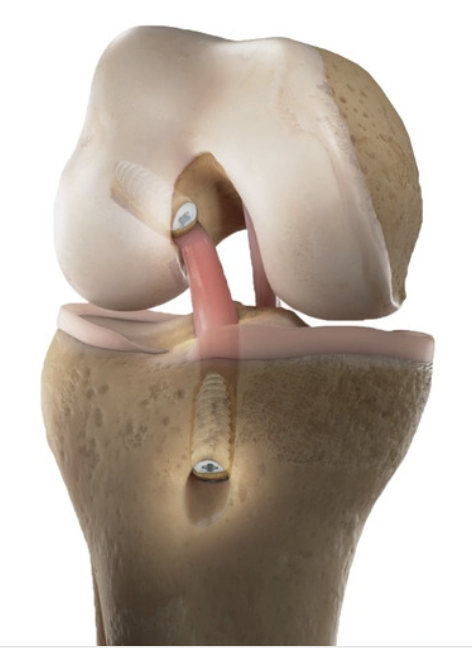
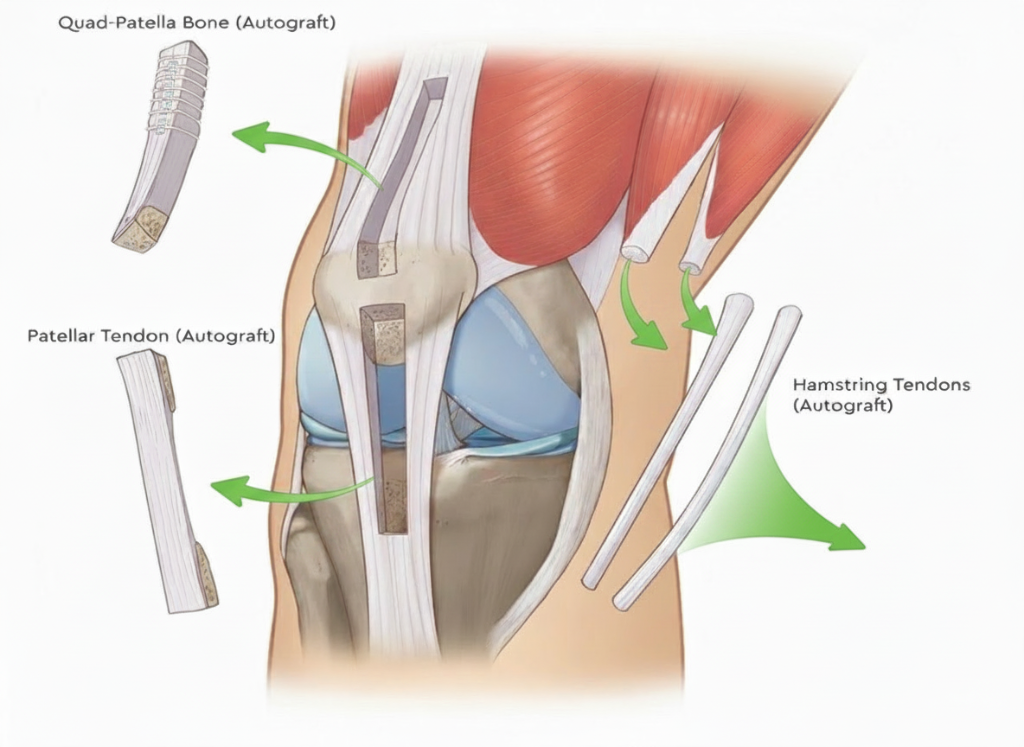
ACL reconstruction is a surgical procedure to replace a torn anterior cruciate ligament — one of the major stabilising ligaments in the knee. The surgery involves replacing the damaged ligament with a tissue graft, typically harvested from the patient's own hamstring, patella or quadricep tendon (autograft), or from donor tissue (allograft). The procedure is performed arthroscopically through small incisions, allowing precise tunnel placement and graft fixation. Modern techniques emphasise anatomic reconstruction, placing the graft in the native ACL footprint to restore normal knee movements and function. Post-operative rehabilitation follows a structured protocol progressing from protected weight bearing to full return to sport, typically over 9–12 months.
Indications
- Complete ACL tear with knee instability
- Recurrent giving-way episodes
- Active patients wanting to return to pivoting sports
- Combined ligament injuries
Recovery
9–12 months to full return to sport. Office work in 2–4 weeks.
The Stability Randomized Clinical Trial
Mr Getgood is co-primary investigator of the multi award winning Stability Trial that has helped optimise the outcomes of ACL reconstruction worldwide, particularly in regards to the use of lateral extra-articular tenodesis. The Stability 2 Trial is the largest randomized study ever to be performed in ACL surgery, the results of which will be released in 2027. This study focuses on the difference between patella tendon, quadriceps tendon and hamstring tendon graft options in young athletes and whether a lateral extra-articular tenodesis should be added to reduce graft failure.
Graft Options
Mr Getgood offers multiple graft sources tailored to your anatomy, activity level, and surgical circumstances. The choice of graft is individualised and discussed during your consultation.
Specialised Techniques
Rehabilitation Programme
A structured, criteria-based rehabilitation programme is essential for ACL reconstruction success and safe return to sport. Through his times as Chief of Surgery at Aspetar, Mr Getgood has adopted their evidence based pathway to ACL rehabilitation and injury prevention. Progression is milestone-driven — time points are approximate guides only. It is vitally important to follow this structured programme with physiotherapy supervision.
| Time Point | Activities Allowed | Target Milestones |
|---|---|---|
Pre-Op Readiness for Surgery |
|
|
Weeks 0–2 Immediate Post-Op |
| |
Weeks 2–6 Early Healing |
|
|
Weeks 6–12 Strengthening |
|
|
Month 3 Start Running |
|
|
Month 4.5 Start Sports-Specific Training |
|
|
Discharge Return to Training / Sport |
|
|
Pre-Op
Readiness for Surgery
Activities
- Pre-operative physiotherapy to optimise knee condition
- Range of motion exercises
- Quadriceps activation and strengthening
- Swelling management
Target Milestones
- >120° knee flexion
- Full extension (0°)
- Minimal swelling
Weeks 0–2
Immediate Post-Op
Activities
- Pain and swelling management
- Restore extension to neutral (0°)
- Prevent blood clots — gentle ankle pumps, walking
- Gentle quadriceps activation
- Partial weight-bearing with crutches
- Ice compression therapy to manage swelling and pain
- Compex/muscle stimulation to assist quadriceps activation
- Blood flow restriction (BFR) therapy during lower limb exercises
Target Milestones
Weeks 2–6
Early Healing
Activities
- Progress range of motion toward 120°
- Gradual weight-bearing progression
- Quadriceps and hamstring strengthening
- Proprioceptive awareness training
- Ice compression therapy to manage swelling and pain
- Compex/muscle stimulation to assist muscle activation
- Blood flow restriction (BFR) therapy during strengthening exercises
Target Milestones
- Extension at or near 0°
- Minimal post-op swelling
- Quadriceps activation achieved
Weeks 6–12
Strengthening
Activities
- Full range of motion restoration
- Progressive resistance training
- Functional movement patterns
- Balance and coordination exercises
- Stationary bike and pool-based cardio
- Ice compression therapy to manage swelling and pain
- Compex/muscle stimulation to assist muscle activation
- Blood flow restriction (BFR) therapy during strengthening exercises
Target Milestones
- Flexion ≥120°
- Extension ≤0°
- Stroke test ≤2
- Active quadriceps contraction
Month 3
Start Running
Activities
- Jogging programme begins (criteria-based)
- Continued lower limb strengthening
- Neuromuscular control drills
- Progressive loading
- Ice compression therapy as needed for swelling management
- Compex/muscle stimulation to assist muscle activation
- Blood flow restriction (BFR) therapy during strengthening exercises
Target Milestones
- Flexion ≥130°
- Extension ≤0°
- Stroke test ≤1
- Quad & hamstring strength ≥70% LSI
- IKDC ≥64%
Month 4.5
Start Sports-Specific Training
Activities
- Sport-specific drills introduced
- Cutting and change-of-direction exercises
- Plyometric loading begins
- Running programme advancing
- Blood flow restriction (BFR) therapy during strengthening exercises
Target Milestones
- Flexion ≥135°
- Extension ≤0°
- Stroke test ≤trace
- Quad & hamstring strength ≥80% LSI
- Running ≥80% LSI
- CMJ ≥80% LSI
- DJ ≥80% LSI
Discharge
Return to Training / Sport
Activities
- Full sport-specific training
- Advanced agility and cutting drills
- Full competitive return (surgeon clearance)
Target Milestones
- Flexion ≥140°, extension ≤0°
- Stroke test ≤trace
- Quads/Hams ≥90% LSI
- Hip strength ABD/ADD/ER ≥90% LSI
- Ankle plantarflexion strength ≥90% LSI
- CMJ / DJ / running / SLHD / CoD mechanics ≥90% LSI
- Surgeon + Physio clearance
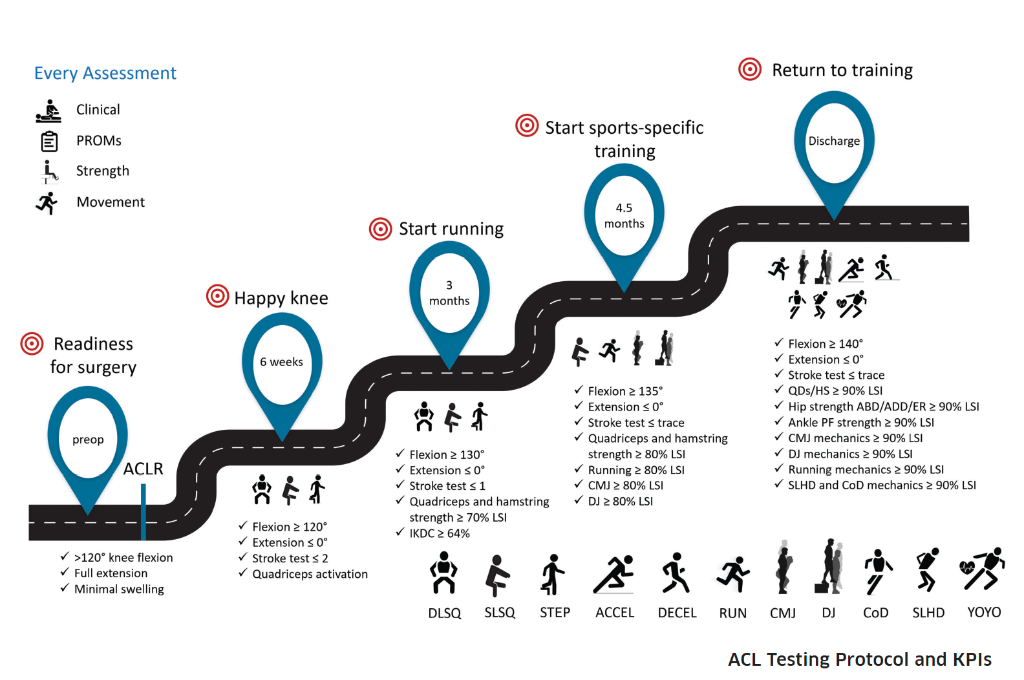
* Timelines are approximate. Exercises are given as examples only and should be directed by your physiotherapist. Progression is criteria-based and directed by your physiotherapist in conjunction with Mr Getgood's clinical review. Individual recovery varies.
Frequently Asked Questions

Supporting Evidence
Noteworthy Publications from Mr Getgood Pertaining to ACL Reconstruction and the Stability Trials
Getgood AMJ, Bryant DM, Litchfield R, Heard M, McCormack RG, Rezansoff A, et al. Lateral Extra-articular Tenodesis Reduces Failure of Hamstring Tendon Autograft Anterior Cruciate Ligament Reconstruction: 2-Year Outcomes From the STABILITY Study Randomized Clinical Trial. Am J Sports Med. 2020;48(2):285–97.
Rezansoff A, Firth AD, Bryant DM, Litchfield R, McCormack RG, Heard M, et al. Anterior Cruciate Ligament Reconstruction Plus Lateral Extra-articular Tenodesis Has a Similar Return-to-Sport Rate to Anterior Cruciate Ligament Reconstruction Alone but a Lower Failure Rate. Arthroscopy. 2024;40(2):384–96 e1.
Nakanishi Y, Hegarty P, Vivacqua T, Firth A, Milner JS, Pritchett S, et al. Quantitative MRI Analysis of Patellofemoral Joint Cartilage Health 2 Years After Anterior Cruciate Ligament Reconstruction and Lateral Extra-Articular Tenodesis. Am J Sports Med. 2024;52(7):1773–83.
Firth AD, Pritchett SL, Milner JS, Atkinson HF, Bryant DM, Holdsworth DW, et al. Quantitative Magnetic Resonance Imaging of Lateral Compartment Articular Cartilage After Lateral Extra-articular Tenodesis. Am J Sports Med. 2024;52(4):909–18.
Heard M, Marmura H, Bryant D, Litchfield R, McCormack R, MacDonald P, et al. No increase in adverse events with lateral extra-articular tenodesis augmentation of anterior cruciate ligament reconstruction - Results from the stability randomized trial. J ISAKOS. 2023;8(4):246–54.
Firth AD, Bryant DM, Litchfield R, McCormack RG, Heard M, MacDonald PB, et al. Predictors of Graft Failure in Young Active Patients Undergoing Hamstring Autograft Anterior Cruciate Ligament Reconstruction With or Without a Lateral Extra-articular Tenodesis: The Stability Experience. Am J Sports Med. 2022;50(2):384–95.
Getgood A, Hewison C, Bryant D, Litchfield R, Heard M, Buchko G, et al. No Difference in Functional Outcomes When Lateral Extra-Articular Tenodesis Is Added to Anterior Cruciate Ligament Reconstruction in Young Active Patients: The Stability Study. Arthroscopy. 2020;36(6):1690–701.
Other Noteworthy Publications Pertaining to ACL Reconstruction
Group MK, Spindler KP, Huston LJ, Zajichek A, Reinke EK, Amendola A, et al. Anterior Cruciate Ligament Reconstruction in High School and College-Aged Athletes: Does Autograft Choice Influence Anterior Cruciate Ligament Revision Rates? Am J Sports Med. 2020;48(2):298–309.
Lynskey SJ, Ambrosanio A, Motesharei A, Jones M, Ball S, Church JS, et al. Return to Play, Career Longevity, and Reruptures After Primary Anterior Cruciate Ligament Reconstruction With Lateral Extra-articular Tenodesis in Professional Soccer and Rugby Players: A Comparison of Hamstring Tendon Versus Bone-Patellar Tendon-Bone Autografts. Am J Sports Med. 2026;3635465261437783.
Mohtadi N, Chan D, Barber R, Paolucci EO. Reruptures, Reinjuries, and Revisions at a Minimum 2-Year Follow-up: A Randomized Clinical Trial Comparing 3 Graft Types for ACL Reconstruction. Clin J Sport Med. 2016;26(2):96–107.