Meniscus Repair
Arthroscopic repair of torn meniscal cartilage to preserve knee cushioning and long-term joint health.
Overview
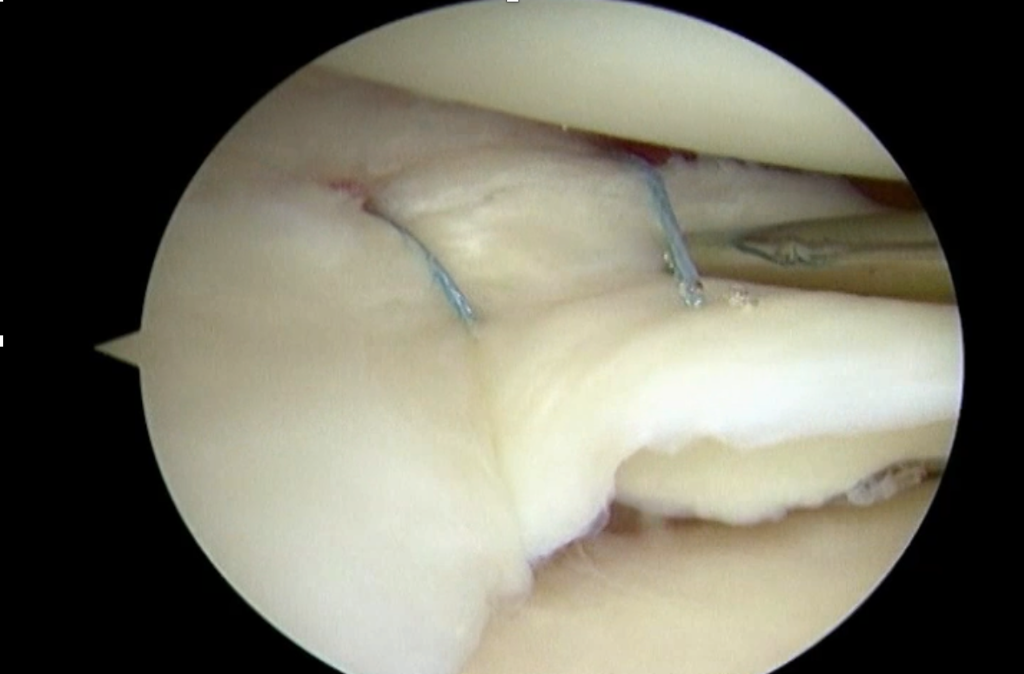
Meniscus repair addresses tears in the crescent-shaped cartilage pads that act as cushions between the femur and tibia. Modern surgical repair techniques minimise trauma while preserving meniscal tissue to protect the joint from premature osteoarthritis. This procedure is preferred over partial removal whenever repair is technically feasible.
Indications
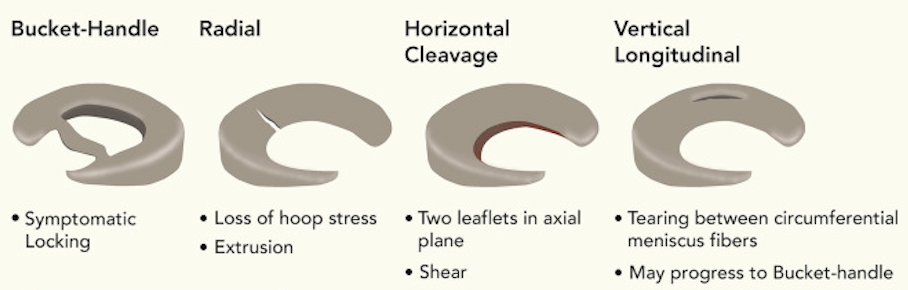
- Bucket-handle meniscal tears
- Peripheral meniscal tears in vascular zone
- Locked knee with displaced meniscal fragment
Recovery
4–6 months for repair; 4–6 weeks for partial meniscectomy.
Repair Techniques
Mr Getgood employs a range of meniscus repair techniques, selecting the approach based on tear location, pattern, stability, and patient demand. The choice of technique is discussed during your consultation and tailored to your individual circumstances.
Rehabilitation Protocols
During his time at Aspetar Orthopaedic and Sports Medicine Hospital Mr Getgood helped develop the following meniscus repair rehabilitation protocols. Two protocols are used depending on tear type and repair stability. Your physiotherapist and Mr Getgood will determine which protocol applies to you.
Throughout the first 3 months of recovery, ice compression therapy and Compex/muscle stimulation are recommended to manage swelling, reduce pain, and assist with muscle activation. Blood flow restriction (BFR) therapy may be used during strengthening exercises for the first 6 months to maintain muscle mass while minimising joint load.
| Protocol 1 — Simple / Stable | Protocol 2 — Simple / Unstable | Entry Criteria | |
|---|---|---|---|
| Tear Type | Longitudinal, vertical tears posterior third meniscus; Horizontal cleavage tears; RAMP lesions | Bucket handle tears; Isolated meniscal tears | |
| Key Restrictions | Caution with OKC Hamstring for RAMP lesions for 6 weeks. Avoid deep loaded flexion >90° for 3 months. No brace required. | Brace required for 6 weeks (0–90° ROM). WB in brace only. Avoid deep loaded flexion >90° for 3 months. | |
| Weight Bearing Start | WBAT from Day 1 (guided by pain and swelling) | WBAT — locked in extension until Week 4; 0–90° from Weeks 4–6 | |
| Brace | Not required | 6 weeks (0–90°, locked at 0° for WB until Week 4) | |
| Fitness Bike | Week 2+ (wounds healed, 110°+ flexion) | Week 6+ (110°+ flexion, no increase in pain/effusion) |
|
| Hydrotherapy | Week 4+ (hospital policy for wound healing) | Week 4+ (movement-based rehab for 2 weeks) |
|
| Hydrotherapy Running | Week 4+ (2-week running progressions if required) | Week 8+ |
|
| Anti-G Treadmill | Weeks 4–6+ | Week 10+ |
|
| Running | Weeks 6–8+ (Accelerated) / 9–11+ (Conservative) | Week 14+ |
|
| Sports Specific Training | Weeks 9–11+ (Accelerated) / 12–14+ (Conservative) | Week 18+ |
|
| Discharge (RTT) | Weeks 12–14+ (Accelerated) / 14–16+ (Conservative) | Week 22+ |
|
Protocol 1 — Simple / Stable
Longitudinal, vertical tears posterior third meniscus; Horizontal cleavage tears; RAMP lesions
Protocol 2 — Simple / Unstable
Bucket handle tears; Isolated meniscal tears
Protocol 1 — Simple / Stable
Caution with OKC Hamstring for RAMP lesions for 6 weeks. Avoid deep loaded flexion >90° for 3 months. No brace required.
Protocol 2 — Simple / Unstable
Brace required for 6 weeks (0–90° ROM). WB in brace only. Avoid deep loaded flexion >90° for 3 months.
Protocol 1 — Simple / Stable
WBAT from Day 1 (guided by pain and swelling)
Protocol 2 — Simple / Unstable
WBAT — locked in extension until Week 4; 0–90° from Weeks 4–6
Protocol 1 — Simple / Stable
Not required
Protocol 2 — Simple / Unstable
6 weeks (0–90°, locked at 0° for WB until Week 4)
Protocol 1 — Simple / Stable
Week 2+ (wounds healed, 110°+ flexion)
Protocol 2 — Simple / Unstable
Week 6+ (110°+ flexion, no increase in pain/effusion)
Entry Criteria
- ≥110° knee flexion
- Minimal/no pain or effusion
- Seated cycling doesn't provoke symptoms
Protocol 1 — Simple / Stable
Week 4+ (hospital policy for wound healing)
Protocol 2 — Simple / Unstable
Week 4+ (movement-based rehab for 2 weeks)
Entry Criteria
- Wound healed (clearance from nursing wound clinic)
- Pain and swelling under control (showing week to week decrease)
- Brace open for WB
- Full WB (or FFWB if applicable)
Protocol 1 — Simple / Stable
Week 4+ (2-week running progressions if required)
Protocol 2 — Simple / Unstable
Week 8+
Entry Criteria
- Minimal / stable effusion
- Active Quads contraction 0°
- Hip Lock
- Alt Leg POGOS
Protocol 1 — Simple / Stable
Weeks 4–6+
Protocol 2 — Simple / Unstable
Week 10+
Entry Criteria
- Symmetrical gait pattern
- Good single-leg squat control
- No swelling post-bike sessions
- Banded Hip Lock with good control
- Banded Wall Drive with good control
Protocol 1 — Simple / Stable
Weeks 6–8+ (Accelerated) / 9–11+ (Conservative)
Protocol 2 — Simple / Unstable
Week 14+
Entry Criteria
- Passed Alter-G Running phase
- No swelling post-session
- SL pogos > 30 reps
- Quads & Hams isokinetic LSI > 70% and/or > 200%BW
Protocol 1 — Simple / Stable
Weeks 9–11+ (Accelerated) / 12–14+ (Conservative)
Protocol 2 — Simple / Unstable
Week 18+
Entry Criteria
- ≥80% LSI in strength, explosive and reactive strength tests
- No symptoms with directional changes
Protocol 1 — Simple / Stable
Weeks 12–14+ (Accelerated) / 14–16+ (Conservative)
Protocol 2 — Simple / Unstable
Week 22+
Entry Criteria
- >90% LSI across all tests (Strength, explosiveness, reactivity, Running and COD testing)
- Surgeon / Physio / Performance staff clearance
- Completion of sport specific drills
* Timelines are approximate. Exercises are given as examples only and should be directed by your physiotherapist. Progression is criteria-based and directed by your physiotherapist in conjunction with Mr Getgood's clinical review. Individual recovery varies.
Recovery following posterior root repair is more prolonged than standard meniscus repair. Strict protection in the first six weeks is essential to maximise meniscal healing and prevent re-tear. Physiotherapy-led rehabilitation is mandatory throughout.
| Milestone | Protocol | Entry Criteria |
|---|---|---|
Tear Type | Radial tears, root tears, complex flap tears | |
Key Restrictions | High risk of gapping with all forces — protect diligently for first 6 weeks. Avoid deep loaded flexion for 6 months. Passive ROM 0–90° for 6 weeks. No squatting for 6 weeks. No loaded deep flexion >90° for 3 months. FFTWB with brace for 6 weeks. | |
Weight Bearing Start | FFTWB (Weeks 0–6) — Brace open. No forces due to TWB status. | |
Full Weight Bearing | Week 6+ | |
Brace Duration | 6 Weeks | |
Fitness Bike | Week 8+ (110°+ flexion, no increase in pain/effusion) |
|
Hydrotherapy | Week 6+ |
|
Hydrotherapy Running | Week 12+ |
|
Anti-G Treadmill | Week 14+ |
|
Running | Week 19+ |
|
Sports Specific Training | Week 23+ |
|
Discharge (RTT) | Week 27+ |
|
Tear Type
Protocol
Radial tears, root tears, complex flap tears
Key Restrictions
Protocol
High risk of gapping with all forces — protect diligently for first 6 weeks. Avoid deep loaded flexion for 6 months. Passive ROM 0–90° for 6 weeks. No squatting for 6 weeks. No loaded deep flexion >90° for 3 months. FFTWB with brace for 6 weeks.
Weight Bearing Start
Protocol
FFTWB (Weeks 0–6) — Brace open. No forces due to TWB status.
Full Weight Bearing
Protocol
Week 6+
Brace Duration
Protocol
6 Weeks
Fitness Bike
Protocol
Week 8+ (110°+ flexion, no increase in pain/effusion)
Entry Criteria
- ≥110° knee flexion
- Minimal/no pain or effusion
- Seated cycling doesn't provoke symptoms
Hydrotherapy
Protocol
Week 6+
Entry Criteria
- Wound healed (clearance from nursing wound clinic)
- Pain and swelling under control (showing week to week decrease)
- Brace open for WB
- Full WB (or FFWB if applicable)
Hydrotherapy Running
Protocol
Week 12+
Entry Criteria
- Minimal / stable effusion
- Active Quads contraction 0°
- Hip Lock
- Alt Leg POGOS
Anti-G Treadmill
Protocol
Week 14+
Entry Criteria
- Symmetrical gait pattern
- Good single-leg squat control
- No swelling post-bike sessions
- Banded Hip Lock with good control
- Banded Wall Drive with good control
Running
Protocol
Week 19+
Entry Criteria
- Passed Alter-G Running phase
- No swelling post-session
- SL pogos > 30 reps
- Quads & Hams isokinetic LSI > 70% and/or > 200%BW
Sports Specific Training
Protocol
Week 23+
Entry Criteria
- ≥80% LSI in strength, explosive and reactive strength tests
- No symptoms with directional changes
Discharge (RTT)
Protocol
Week 27+
Entry Criteria
- >90% LSI across all tests (Strength, explosiveness, reactivity, Running and COD testing)
- Surgeon / Physio / Performance staff clearance
- Completion of sport specific drills
* Timelines are guidelines only. Progression is criteria-based and directed by your physiotherapist in conjunction with Mr Getgood's clinical review.
Frequently Asked Questions
Supporting Evidence
Noteworthy Publications from Mr Getgood Pertaining to Meniscus Repair
Runer A, Kolevar MP, Nazzal EM, Hughes JD, Kopf S, Krych AJ, et al. Managing the meniscus Part 2: Traumatic tear patterns, biologic augmentation, transplantation, innovation and future research. Knee Surg Sports Traumatol Arthrosc. 2026
Li Y, Redgrift AG, Hiranaka T, Getgood A, Willing R. Contact mechanics following medial meniscus posterior root tears and suture anchor repair in simulated gait: A cadaveric study. J Biomech. 2025;189:112837.
Hiranaka T, Redgrift AG, Li Y, Madia LM, Willing R, Getgood A. Simulated Biomechanical Analysis of Optimal Knee Alignment for Treating Medial Meniscus Posterior Root Tears. Orthop J Sports Med. 2025;13(7):23259671251344944.
Marmura H, Firth A, Batty L, Bryant DM, Getgood AMJ, Group SS. Meniscal repair at the time of primary ACLR does not negatively influence short term knee stability, graft rupture rates, or patient-reported outcome measures: the STABILITY experience. Knee Surg Sports Traumatol Arthrosc. 2022;30(11):3689–99.
Kolaczek S, Hewison C, Caterine S, Ragbar MX, Getgood A, Gordon KD. Analysis of 3D strain in the human medial meniscus. J Mech Behav Biomed Mater. 2016;63:470–5.